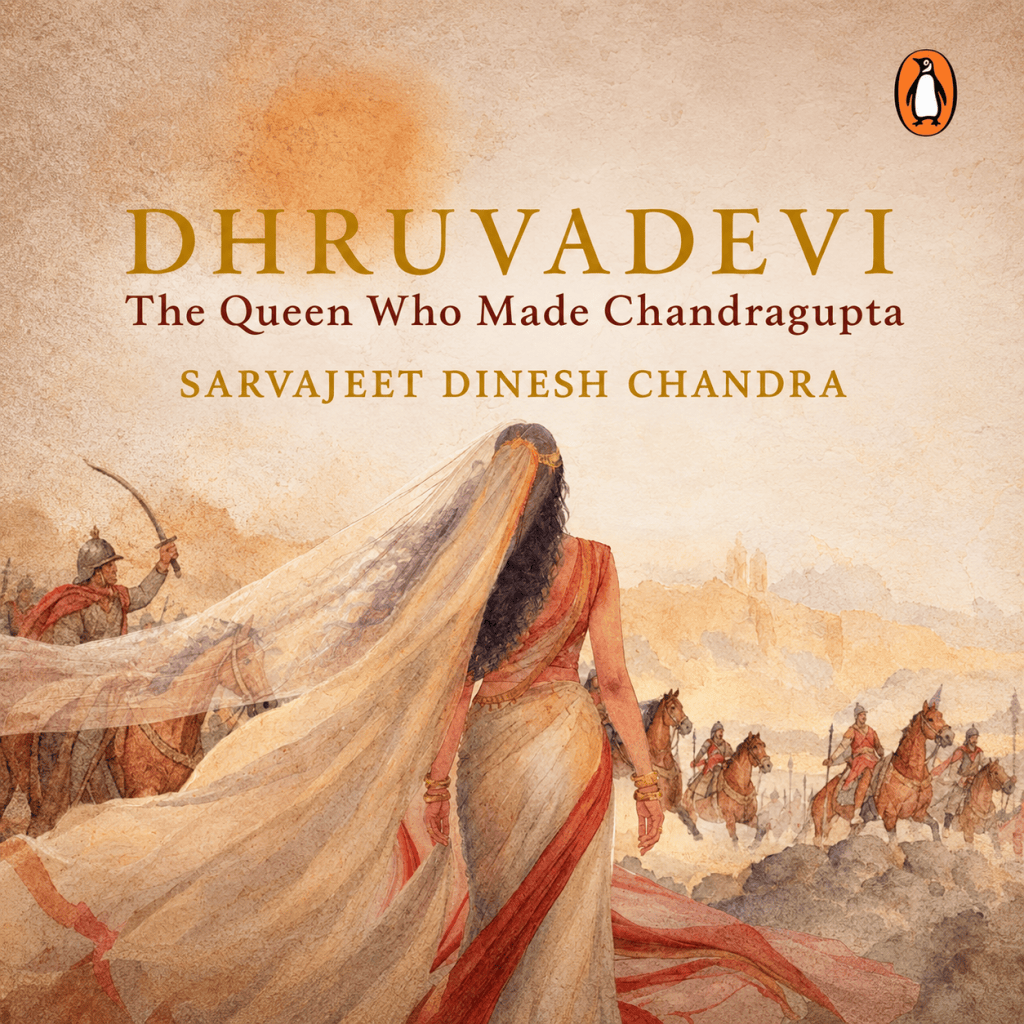
Most people expect a historical novel to deliver sword fights and loud kings. Sarvajeet Dinesh Chandra, spent 25 years fixing broken businesses and building brands before going back 1,600 years to write Dhruvadevi: The Queen Who Made Chandragupta. On Jagged with Jasravee podcast, he explained why a Gupta queen has more to teach a modern boardroom than most management books.
The Only Adult in the Room: Dhruva Devi as a Turnaround Operator
Ask Sarvajeet what kind of leader Dhruva Devi would be today and the answer is not “warrior queen”. She is the chief queen of the Gupta empire, married to a weak king, and she has to rescue a failing business. Sarvajeet says, “She is more like a turnaround operator.”
Her toolkit looks familiar to anyone who has rescued a struggling company:
- She stitches alliances rather than winning every argument.
- She negotiates with enemies when she is not yet strong enough to fight them.
- She works behind the scenes and rallies the old guard & the new blood together.
- She listens first, then asks the difficult questions.
Sarvajeet observes that , “In a boardroom she would listen a lot, but then she will raise some difficult questions.”
| Ramagupta (the king) | Dhruva Devi (the queen) | |
|---|---|---|
| Style | Ego, status, the title of king of kings | Coalition building, negotiation |
| Relationship with risk | Runs Magadha to the ground | Salvages it quietly |
| Source of power | Position | Influence, Licchavi roots, warfare education |
Mass Versus Velocity: How the Challenger Beat the Giant
The Sakas ruled the west of India, including Baruch and Ujjain, for 400 years. Sarvajeet is clear that “they were not, you know, fly-by-night operators.” They behaved like the sharpest challenger brand imaginable.
| Guptas (the leader) | Shakas (the challenger) | |
|---|---|---|
| Strength | Large infantry, elephants, mass | Cavalry, speed, composite bows |
| Home terrain | Flat Gangetic plain | Rugged Malwa, narrow passes, black cotton soil |
| Tactic | Overwhelming force | Ambush, feints, cutting long supply lines |
Sarvajeet makes a point that the Guptas’ strengths were neutralised the moment they entered Malwa. His lesson for small players is blunt: “every challenger brand has to realise where to fight and where to hide.”
He then moves from the steppe to the supermarket shelf. Ghari took on HUL’s Wheel by owning regional tier two and tier three towns, using the housewife’s belief that more foam meant better cleaning, and winning the small kirana shops. In his words: “They chose the terrain, they chose the areas where they will fight, they chose the positioning.”
The challenger playbook, in four lines:
- Pick the terrain where the leader’s size becomes a burden.
- Build the proposition around a genuine consumer insight.
- Win distribution through channels the giant undervalues.
- Incentivise & value the channel partners more than the leader does.
Is History a Pack of Lies? Not Quite, Says Sarvajeet
Jasravee asked the awkward question directly: is history just a pack of lies? Sarvajeet’s answer is more careful than a yes or no. “History is not a pack of lies. It is, you could say it is a pack of half-truths.”
He calls history “the winner’s mirror” and points out that ancient Indian history was largely the story of Pataliputra, Magadha and Delhi. The contribution/influence of other regions of India was ignored. He cities the examples of Western Sakas & Rastrakutas.
The Sakas were labelled as ‘mlecchas’ or barbarians though they had thriving commercial cities, a stable currency that the Guptas later had to emulate, and commissioned the first long Sanskrit inscription at Junagadh. Similarly, the Rashtrakutas, based in Karnataka carved the Kailasa temple out of a mountain, which Sarvajeet believes has to one of seven wonders of the world. Yet, as he puts it, “nobody knows about the Sakas and the Rashtrakutas”.
The surviving play Devi Chandraguptam shows the spin at work. In it, Chandragupta disguises himself as the queen and kills the Shaka ruler. Sarvajeet’s reaction is wonderfully dry: it is hard to believe the Shakas “will be so dumb that they would mistake a man for a woman.” His reading is that the play exists to hide something humiliating, namely that a Saka king besieged the Guptas and forced a humiliating deal on them.
Narrative Was Infrastructure: Coins Were Reels, Inscriptions Were YouTube
This is the line that every brand manager should write on a sticky note: “In that era, narrative was infrastructure.”
Sarvajeet’s translation of ancient media into modern terms is as follows.
| Ancient tool | Modern equivalent (Sarvo’s words) |
|---|---|
| Coins | “reels” |
| Inscriptions | “YouTube videos” |
| Puranas and temples | A well-organised network of myth-making |
Samudragupta’s inscriptions equated him with Vedic deities such as Yama and Agni, while his coins showed him as an archer, a tiger slayer and also a man playing the veena. That was a deliberate softening of the emperor brand. It gave the Napoleon of India, “a softer edge, a more humane edge.”
The Villain Who Was Not a Villain
Many thrillers need a monster. Sarvajeet declined to build one. “Nobody’s really actually painted like a villain.”
The Saka king Rudrasena is, in Sarvajeet’s words, a “general of the century”, and “there is nothing evil about what he’s doing.” His demands serve his own people’s interests. The novel also keeps shifting the balance of power, so the reader never knows who is truly winning. For strategists, that is a useful reminder: your competitor is rarely evil, and is usually just playing his game from a different position.
Stitching Half a Subcontinent Together With a Story
The Guptas ruled from Punjab to Assam and almost down to the Deccan. A fisherman in Tamil Nadu, a farmer on the Gangetic plain and a forest tribal share very little. Sarvajeet explains how the Puranas and the idea of avatars solved that problem:
- A local deity, such as a tribal fish goddess in Bengal, is declared an avatar of a larger figure like Durga.
- Local rulers are linked into ancient lineages.
- Everyone ends up attached to one civilisational thread, so that “people started believing that they are part of one big story.”
- Important regional deities are assimmiliated. Even the Buddha was absorbed as an avatar.
The Guptas also pushed Vishnu to the front and called themselves, supreme devotees of Vishnu Param Bhagavata. They put Garuda and Lakshmi on their coins to signal to the masses that they and Vishnu were on the same plane as the preserver of order.
Crucially, this was competition, not coercion: “It was a intellectual competition going on. There was no forceful conversion.”
Kumaragupta even gave villages to support Nalanda. Sarvajeet’s concludes: “even now you can’t stitch this country on force.”
Writing the Woman Who Was Not in the Room
Sarvajeet’s research about his novel Dhruvadevi began with two plays, Devichandraguptam and Jaishankar Prasad’s Dhruvaswamini. His protagonist Dhruvadevi is neither a warrior nor a victim, and he contrasts her with Draupadi:
| Draupadi | Dhruva Devi | |
|---|---|---|
| Nature | Mythological figure of the epic | Historical figure, novelised |
| When humiliated | Seeks out Lord Krishna | “Refused to be treated as property and she resisted, she rebelled” |
| Closest comparison | Epic heroine | Empowered Saka women of the era |
Five Takeaways for Strategists
- A turnaround rewards listening, alliances and well-timed questions over bravado.
- Challengers win by choosing the terrain, not by copying the leader.
- History, like brand history, is a pack of half-truths written by whoever holds the pen.
- Narrative is infrastructure, so build it deliberately.
- Unity comes from a story that includes people, not from force.
And a closing note for readers: the sequel of the novel is planned around Prabhavati, Chandragupta’s daughter. Asked about who Sarvajeet will cast for his novel if it is made into a film/OTT series, Sarvajeet’s dream cast includes Alia Bhatt for Dhruvadevi and Ranveer Singh for Chandragupta!
Sarvajeet’s Novel ‘Dhruvadevi: The Queen Who Made Chandragupta’. Available on Amazon India, Flipkart, Crossword & Select Bookstores
Novel Also Available on Kindle Worldwide. Kindle US, Kindle UK, Kindle Australia


Leave a Reply