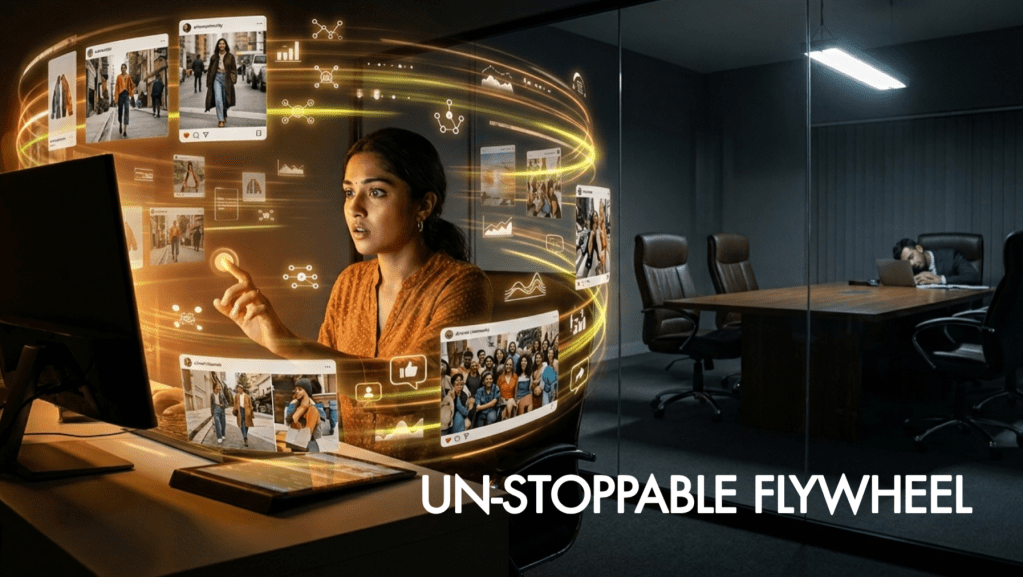
India’s marketing landscape is in the middle of a slow-motion crisis. Brands are spending more, reaching more, and being remembered less. The flywheel has replaced the funnel. AI is reshaping discovery. The consumer is no longer watching. They are now seeking, scrolling, and letting algorithms decide. So what does a brand manager do in 2026? Here is a clear-eyed look at what is broken, what still works, and what you absolutely must do differently.
The Funnel Is Dead. Welcome to the Flywheel.
For decades, marketers lived by the funnel: awareness, interest, desire, action. Clean, linear, predictable. That world is gone. Media fragmentation killed it quietly before AI even arrived.
As Soumya Mohanty, Kantar explains it plainly:
“It is no longer linear or a funnel. It is perpetual exposure and perpetual influence. You are optimising for attention and optimising for influence.”
Today a consumer discovers a brand on a quick-commerce app, sees an ad mid-cricket match, gets a recommendation from an LLM, and makes a decision in seconds. The journey is simultaneous, not sequential. All three stages of awareness, desire, and intent can collapse into one moment.
The practical implication is significant:
- You cannot afford to neglect the top of the funnel and chase only last-click metrics
- Every touchpoint is now a potential conversion or a potential defection
- Brand building and performance marketing must be integrated, not siloed
85% of Brands Have No Emotional Core. Is Yours One of Them?
Here is a number that should keep every brand manager up at night. 85% of brands fail to build strong emotional relevance. This is not a creative failure. It is a strategic one.
The culprit, according to Soumya, is fragmentation and the relentless chase for the premium urban consumer:
“All brands want to become premium. All brands want to appeal to the same target audience. And that target audience, people like us or Gen Z, are inherently flirtatious and inherently less brand loyal.”
Meanwhile, the vast, aspiring middle India is being abandoned. Rural consumers are more brand loyal. They are more willing to pay a premium and are hungry for familiarity. Yet, they are being ignored by brands chasing the same sliver of metropolitan consumers.
The brands that have survived and thrived share one thing: a sharp, consistent emotional core. Royal Enfield did not sell motorcycles. It sold freedom and adventure. Tanishq reinvented itself from a gold retailer into a custodian of Indian womanhood and ritual. Maggi is not noodles; it is nostalgia.
The diagnostic test is brutally simple, as Soumya puts it:
“When I think of brand X, does something come to my mind? And what comes to my mind should also come to your mind.”
If the answer is a shrug, you have work to do.
Survivors vs Thrivers: What Separates Them
| Dimension | Survivors | Thrivers |
| Brand positioning | Vague or category-dependent | Sharp, emotionally resonant |
| Emotional core | Weak or inconsistent | Strong and consistently reinforced |
| Category strategy | Narrow definition | Broad playground, meta thinking |
| Rural strategy | SKU downsizing only | Aspirational, culturally rooted |
| Media approach | TV repurposed for digital | Platform-native, same proposition |
| LLM presence | Not tracked | Audited and optimised |
Only 50% of TV Ads Work on Digital. Stop Re-purposing Them.
This is perhaps the most ignored insight in Indian marketing. Brands routinely take a television ad, trim it down, and push it across Instagram, YouTube, and connected TV. It does not work. Half the time, by definition.
The reason is psychological. When you watch television, you are in a communal, passive, lean-back mindset. When you are on Instagram, you are scrolling at speed, in control, making micro-decisions every second. The same ad fails to bridge that gap.
“When I am on Insta, I am in a very different mindset. The format has to be platform-specific. But my proposition cannot be different.”
The book-to-film analogy is instructive. When converting a novel into a film, you keep the plot. However, you speak in the grammar of the big screen. The same discipline applies across every platform. Same story, different language.
The practical checklist for a brand manager adapting across platforms:
- Understand the attention dynamics of each platform before creating content
- Keep the core proposition identical across Instagram, YouTube, OTT, and quick-commerce
- Format and frequency must be platform-native, not repurposed
- Over-frequency on digital does not prime the consumer; it irritates them
- Connected TV behaves more like traditional TV than digital, plan accordingly
Ad Recall Is Falling Off a Cliff. VTR Is Lying to You.
View-through rates, engagement rates, click-throughs. These metrics are broken. Not because the data is wrong, but because they measure inputs, not outcomes. A consumer can watch an ad and remember nothing about it. Increasingly, that is exactly what is happening.
“If you go to a consumer today, the amount of ad recall has dropped. People do not remember advertising because they are being exposed to so much of it.”
Each platform has invented its own engagement metric, none of which talk to each other. Television gave us a single source of truth. Digital gave us a tower of Babel.
The solution is to track the consumer’s mind, not the platform’s dashboard. Two metrics matter the most. They are share of search, which measures curiosity and intent, and share of voice within LLM responses. This measures how the brand appears when an AI recommends. These together tell you whether your spending is actually building anything in the consumer’s head.
The LLM Is the New Search Bar. Are You In It?
This is the strategic shift most Indian brands have not yet processed. Google search measures curiosity. LLMs make decisions. When a consumer asks an AI to recommend a product, the AI does not show ten blue links. It gives an answer. If your brand is not in that answer, you do not exist for that consumer in that moment.
“The decision process LLM will take away a lot of it. I will not only search, I will also ask it to recommend. I will also then ask it to tell me why you are recommending.”
What makes this harder to game is that LLMs prioritise credibility over virality:
“Just because something is viral or trending might not get picked up at all. The LLM will analyze all the sources. It will identify where there are better reviews and more ratings.”
The sources that LLMs trust most are exactly the ones that Indian brands have been neglecting. These include digital newspapers, credible review sites, and PR placements. The print-is-dead era may need a quiet rethink.
LLM Visibility: What Drives It
| Factor | Impact on LLM Visibility | Action Required |
| Credible media mentions | High | Invest in digital PR and quality publications |
| Review quality and volume | High | Build authentic review ecosystems |
| Social chatter (viral) | Low to medium | Do not rely on virality alone |
| Paid advertising | Minimal | Cannot buy your way into LLM recommendations |
| SEO-optimised brand content | Medium | Publish substantive, useful content |
Retail Media Is Expensive. Make It a Channel, Not a Media Buy.
Quick-commerce and e-commerce platforms are the new battleground, and the cost of visibility on them is rising fast. Many brands treat these platforms as a media buy. They pay for shelf space the way they would pay for a print ad. That is the expensive way to do it.
The smarter approach is to build predisposition upstream through brand building. This ensures that when a consumer arrives on a quick-commerce platform, they are already primed to choose you. Treat the platform as a channel, not a media property.
“If you want them to behave like a media, then be prepared to pay the price of it. Or build predisposition and make it behave like a channel for you.”
2026-2027 Will Be a Reckoning. Build Now or Get Left Behind.
The speculative era of Indian brand valuations is coming to an end. For years, the rising tide of India’s organic growth lifted all boats. Investors were not asking hard questions. That is changing.
“I would have even sharper data in 2027 because this year is going to be a brutal correction. Only those brands which are super strong in the consumer’s mind will show good earnings growth.”
The brands that survive will be those that have consistently built genuine emotional relevance. They show up on LLMs. They respect the rural consumer. They integrate their brand story across every touchpoint.
The brands that will not survive are the ones that mistook spending for building.
The Brand Building Checklist for 2026
| Imperative | Question to Ask | Red Flag |
| Think meta | Have I defined my category broadly enough? | Brand defined by product feature alone |
| Emotional core | What does my brand make people feel? | No consistent answer across the team |
| Messaging clarity | Is my proposition the same across all platforms? | Different messaging per platform |
| Platform adaptation | Am I executing to the mindset of each platform? | Repurposed TV ads on Instagram |
| LLM presence | How does my brand appear in AI recommendations? | Not tracked at all |
| Consumer bullseye | Can I describe my target consumer in one sentence? | Multiple conflicting target definitions |
| Top of funnel | Am I feeding awareness consistently? | All budget on last-click performance |
 Jagged with Jasravee, the Marketing Show
Leave a comment